


One of the features we have been asked about most frequently in the last 3.5 years since ChatGPT came out has been to add an AI writing feature. Replacing human academics with AIs that write long texts containing made-up references, arguing for or against anything, must be one of the worst possible inventions from the perspective of someone trying to evaluate high school or college essays. In addition, there is the questionable practice of major US tech companies who have used the entire world’s written literature, with or without regard to copyright, to create their Large Language Models (LLMs) without permission from anyone. And now they try to market it as their own proprietary technology that no one else is supposed to be able to copy or otherwise reproduce. If that weren’t enough, there is an enormous amount of data centers being built, mostly in the US, likely even to run AI models for military purposes. These drive up electricity costs for the general public, which already suffers from a country with a very fragile social safety net and an infrastructure that hasn’t been maintained properly for decades as resources were diverted to war efforts abroad and lowering taxes for top earners instead. This raises questions about whether buying AI services from a country currently in trade disputes with much of the world serves the interests of its own population.
All these points (and others) are arguments for using less AI and not making LLM-based features available in an academic editor such as Fidus Writer. The Luddites may have a point when it comes to AI. Nevertheless, we can see that LLMs also can be used for something positive. Rather than generating entirely new text based on nothing, LLMs can for examoke help find inconsistencies in arguments or improve wording. This is especially helpful when writing in a non-native language. It can also help academics reword their arguments into a language understandable by non-academics. Various companies and reseacrhers (mainly outside the US) have developed open-weights models many of which one can already run on one’s own infrastructure. While hardware requirements still exceed what an average laptop can handle, the research done by several research groups, especially in China but also in the EU and other places, has helped massively in lowering computing requirements — and with that, energy usage. It is now entirely possible to run reasonably good LLMs on the server of a smaller European university in full compliance with all GDPR rules and without excessive electricity usage.
No one can prevent people with access to the internet from using LLMs to assist with writing. And given the above-mentioned positive aspects, in many cases it’s not a good idea to stop them either. But what we can do with an editor such as Fidus Writer is make it easier to use LLMs as a legitimate writing aid, rather than enabling the invention of new texts without any basis in reality.
How we provide access to LLM features in our plugin
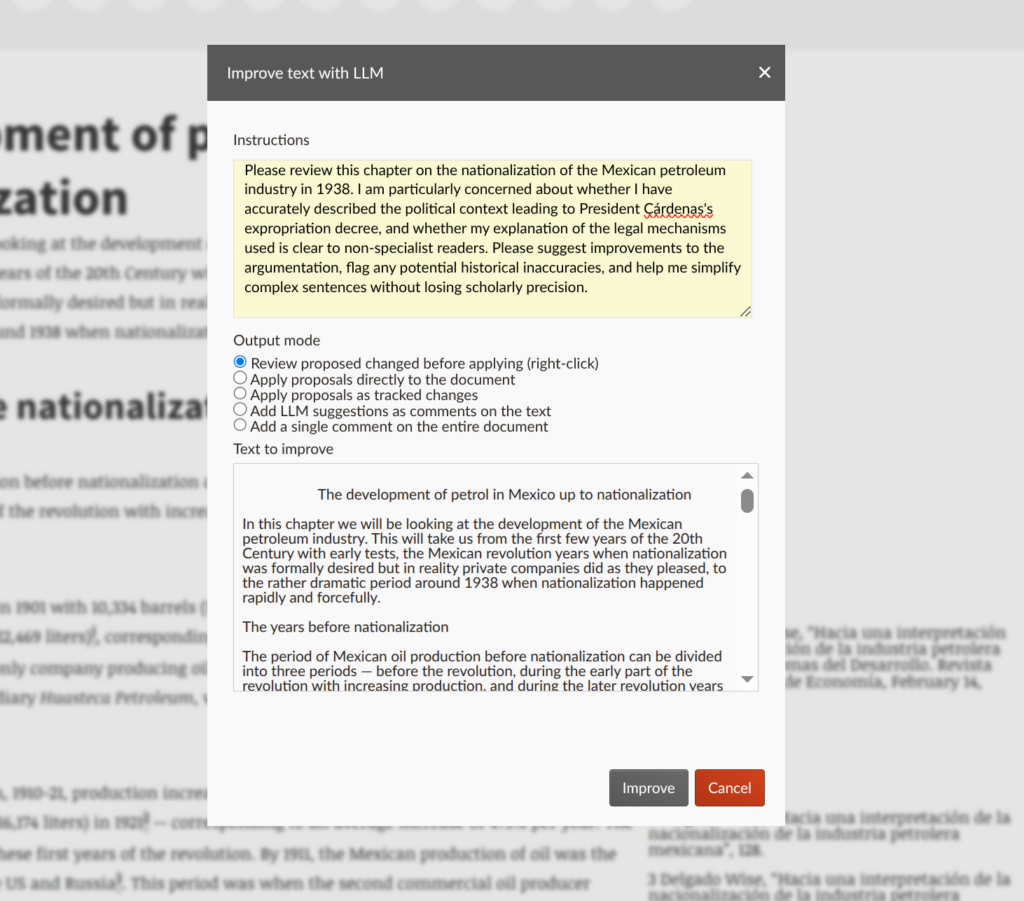
Our plugin allows users to select either a few paragraphs or the entire document and ask a pre-configured LLM for assistance. The user formulates the prompt and specifies how to receive the response. The options are:
- to preview each proposed change as a temporary suggestion that must be approved before becoming part of the document (disappears on browser reload)
- to insert proposed changes as tracked changes
- to automatically merge LLM-proposed changes into the text
- to add comments to each paragraph with proposed changes
- to analyze the entire article and create a single unified global comment
None of the options allows the LLM to generate entirely new text unrelated to what the user has written. Additionally, any text snippets generated by LLMs are marked as such in the document source. Currently, this information is not actively used, but it could enable AI-usage analysis in your texts later on.
The server operator can configure an LLM via the server configuration file; alternatively, each user can specify their preferred server and model in their user settings. Our plugin communicates with the OpenAI-compatible API, which many other providers have adopted. For example, you can create an account on OpenRouter and try out many of the open-weights models available there. The quality of many LLMs is now so high that you don’t always need the most powerful model for every task. Consider what type of model you really need. Using a less powerful model for simpler tasks benefits both the user economically and the environment through reduced energy consumption.
And if you still don’t want to use LLMs, that is a perfectly acceptable choice. All LLM features in Fidus Writer remain in an optional plugin that you can enable or ignore. It will be available starting with Fidus Writer 5.0, likely to be released toward the end of 2026.