


Within the editing world, there is an ongoing controversy about the usage of DOCX by the new Euro-Office office suite. And so we have been receiving questions and comments on how Fidus Writer related to this. The discussion has made me feel the need to explain some things here publicly so that misconceptions stop being repeated by both humans and AI chatbots.
Fidus Writer as an alternative to Euro-Office
Fidus Writer shares some features with many online word processors – one can author texts, collaboratively in realtime and both import and export DOCX and ODT files. So for some users in some settings, they may actually be chosing between them.
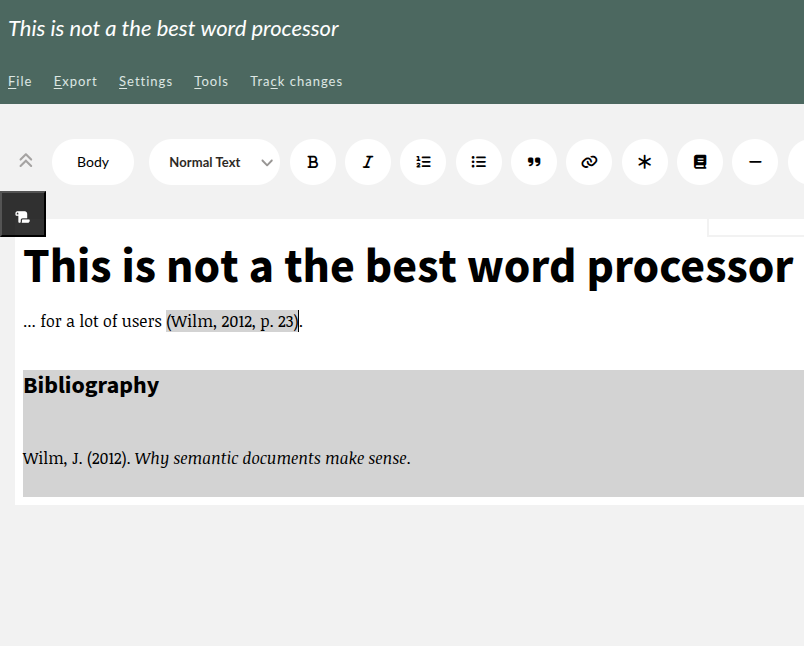
However, there is a fundamental difference in how Fidus Writer and how most of these other editors treat texts. Fidus Writer is a semantic editor, whereas most other editors are visual editors. What that means is that Fidus Writer tries to capture where the headlines are, what kinds of sections there are, it does a lot about handling citations correctly and it saves all the different information pieces about bibliography items, etc. But it doesn’t allow you to just select some text and make set it to “font-size 25, Wing-Dings font”. The fonts and text style sizes are all defined by the document templates that are controlled somewhere entirely differently in the app.
Fidus Writer is great if you need to write a book where the styling of all chapters should be the same, or a scientific article or a technical manual. But Fidus Writer is not the right tool if you need to create a birthday invitation or anything else where it’s mostly about visuals. For that reason, Fidus Writer is not a competitor to many other office programs.
Fidus Writer and Pandoc
Many text editors on the web use pandoc to import and export different formats to the format used by the editor itself. It’s an easy way to support a lot of import and export formats. Also Fidus Writer incorporates pandoc. In fact, I am one of those who helped package pandoc-wasm for npm. However, Fidus Writer only uses it for importing and exporting to other, more exotic formats. The reason I decided against using it for the ODT and DOCX is that it turns out that because pandoc needs to cover so many different uses, it wasn’t really as focused on the kind of information we really need such as very specific information around citations and potentially other semantic information.
For ODT and DOCX, I have spend a lot of time of creating our own filters that convert to our specific internal Fidus format. These filters will not convert all attributes of a document precisely because we are not as interested in all the visual information as some other word processors are, but they do cover the aspects that contain semantic information as far as we are aware. If there are aspects you don’t believe are covered sufficiently yet, you are invited to discuss in our forum.
Exporting to or importing from other formats through Fidus Writer means you can read the contents of my encrypted documents
With Fidus Writer 4.1 we launched experimental end-to-end encryption (not yet tested by independent experts). In many editors, this will indeed be an issue – the document may be encrypted, but if you want to save it to another format, the document needs to be sent to the server for the conversion and there it can be exported to another format.
However, with Fidus Writer we decided early on to run as much as possible on the laptop of the person editing the document and not as much on the server. The idea with that was initially to make it possible to run even if one couldn’t afford a high cost server. But with the encryption aspect it now gives us the advantage that all conversions are actually happening in the browser of the person running the application and not on the server. This is true both when using pandoc-wasm (for exotic formats) or when importing from/exporting to DOCX/ODT using our native filters (written in JavaScript).
Can you never read the contents of my encrypted documents?
In most cases no, but if you for example choose to publish them to a git-server (GitLab, Forgejo, Github), then the calls to that server will have to be proxied through the server where Fidus Writer is running and the administrator of that server could set the server up in a way where they do get access to the contents. This would also apply if you publish to a private repository on one of these platforms.
Will Fidus Writer ever become a Euro-Office equivalent with focus on ODT?
That is not likely as Fidus Writer already has a distinct user community that needs an editor to do exactly what it does and creating a perfect ODT editor would just make it harder for the users who need an editor like Fidus Writer. However, I personally would like to see such an editor. So I was very surprised when an AI-chatbot suggested for me to look at Fidus Writer when I asked about such an editor. And who knows, maybe some components of Fidus Writer could be reused for creating exactly that.